

When Is It Okay to Pressure Wash, and When Should You Use a Gentler Cleaning Method?
By early summer, a lot of homes around Western Washington are ready for a good exterior cleaning.
The spring pollen has settled in. Driveways and patios are getting more use. Decks are being used again. Siding may have algae, mildew, dirt, or spider webs showing up. Walkways can start looking dingy. And once the sun comes out, all of those dirty areas become a lot more noticeable.
That’s usually when homeowners start wondering, “Can I just pressure wash this?”
Sometimes the answer is yes. Sometimes the answer is absolutely not. And sometimes the answer is, “It depends.”
A pressure washer can be a great tool, but it is not the right tool for every surface. Used correctly, it can clean durable surfaces quickly. Used incorrectly, it can damage your home, shorten the life of certain materials, or create problems you won’t notice until later.
So before you pull out the pressure washer this summer, here’s a simple guide to what is usually safe to pressure wash, what should never be pressure washed, and what needs a little more caution.
Quick reference guide
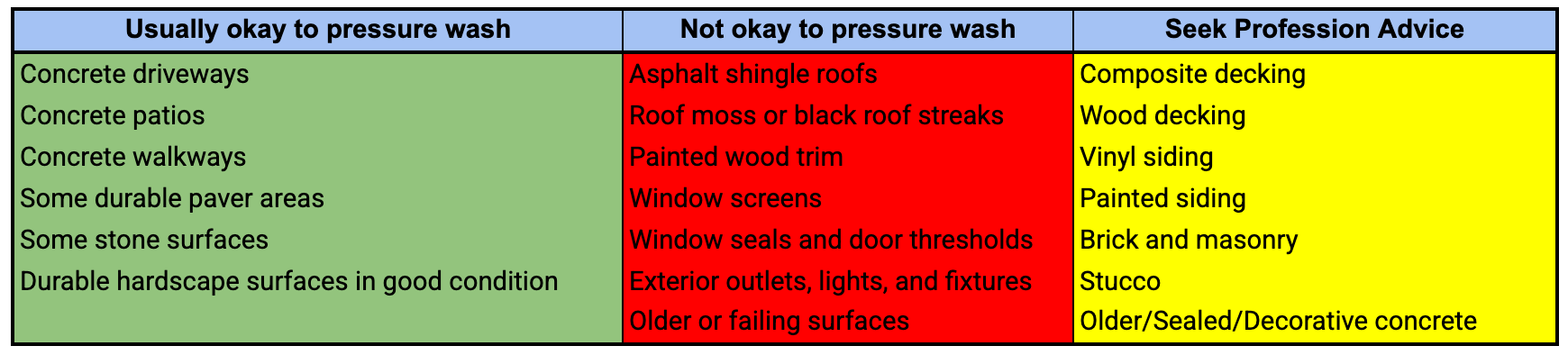
This table is not meant to replace common sense or manufacturer instructions, but it gives you a good starting point. The safest approach is to match the cleaning method to the surface instead of treating everything around your home like concrete.
Why summer grime shows up so quickly
Summer is when people tend to notice exterior dirt the most because they are outside more often.
You may be using your patio again, hosting family, grilling, walking across the driveway every day, or finally paying attention to the deck after months of rain. In our area, spring and early summer can leave behind a mix of pollen, algae, moss residue, mildew, dust, and general grime.
Concrete may look darker than it used to. Siding can have green or black streaks. Deck boards may feel slippery. Walkways can get stained from organic buildup. Roofs may have moss or dark streaking. None of this is unusual here, but it does need to be cleaned the right way.
The key is knowing when to use pressure and when to use a softer cleaning method.
Surfaces that are usually okay to pressure wash
Some surfaces are durable enough to handle pressure washing when it is done correctly. The most common example is concrete.
Concrete driveways, patios, and walkways
Concrete is one of the better candidates for pressure washing because it is hard, flat, and durable. Driveways, patios, and walkways can usually be pressure washed safely when the right equipment, pressure, and technique are used.
That does not mean concrete is impossible to damage. Too much pressure, the wrong nozzle, or holding the wand too close can leave lines, surface marks, or uneven cleaning patterns. Older concrete, decorative concrete, and previously sealed concrete may need extra care.
But in general, if you are looking at a standard concrete driveway, patio, or walkway, pressure washing is often an appropriate cleaning method.
Pavers and some stone surfaces
Pavers and certain stone surfaces can often be cleaned with pressure, but they need more care than basic concrete.
The concern with pavers is that aggressive pressure washing can remove joint sand, disturb the base, or leave the surface looking uneven. Natural stone can also vary a lot. Some stone is very durable, while softer stone can be etched or damaged.
These surfaces are not automatic “no” surfaces, but they should not be blasted carelessly either.
Surfaces you should not pressure wash
This is where homeowners can get into trouble.
Some surfaces are not built to handle high pressure. In those cases, the goal should not be to blast the stain away. The goal should be to use the right cleaning solution, let it do the work, and rinse with low pressure.
Asphalt shingle roofs
Asphalt shingle roofs should never be pressure washed.
High pressure can remove granules from the shingles, force water underneath the roofing system, damage the shingles, shorten the life of the roof, and potentially create warranty issues. Even if the roof looks cleaner afterward, you may have caused damage that is not immediately obvious from the ground.
Moss, algae, and black streaks on a roof should be treated with a proper soft wash process. The cleaning solution does the work. The roof does not need to be blasted with pressure.
This is probably the most important takeaway in the whole article: if you remember nothing else, do not pressure wash an asphalt shingle roof.
Painted wood and painted trim
Painted wood, painted trim, fascia, and other finished surfaces can be damaged by pressure washing. High pressure can strip paint, force water behind boards, rough up the surface, and create areas that need repainting sooner than expected.
If the paint is already peeling, pressure washing will usually make that worse.
Windows, screens, seals, and exterior fixtures
Windows and screens should not be hit directly with high pressure. The same goes for window seals, door thresholds, exterior outlets, light fixtures, cameras, and other sensitive areas.
Pressure can tear screens, damage seals, force water into places it should not go, and create leaks. These areas need a lighter touch.
Older or failing surfaces
If a surface is already cracked, loose, rotting, flaking, or failing, pressure washing can speed up the damage.
Loose mortar, aging brick, old wood, damaged siding, and cracked concrete all need to be evaluated before cleaning. Sometimes the issue is not the dirt. Sometimes the material itself is already compromised.
Surfaces that depend on the material and condition
This is the category that trips people up the most.
A lot of surfaces are not a simple yes or no. They depend on the material, age, condition, manufacturer recommendations, and the method being used.
Composite decking
Composite decking is one of the best examples of a “maybe” surface.
Some composite deck manufacturers allow careful pressure washing with specific limits. Others recommend lower pressure, soft washing, soap and water, or avoiding pressure washing altogether. Even within the same general category of composite decking, the cleaning instructions can vary by brand, product line, and age of the deck.
That means you should not assume every composite deck can be cleaned the same way.
Trex, TimberTech, Fiberon, MoistureShield, DuraLife, Envision, and other manufacturers may each have their own care and cleaning recommendations. Some may allow pressure washing up to a certain PSI with a fan tip and proper distance from the surface. Others may warn against certain cleaners, harsh chemicals, abrasive tools, or too much pressure.
The safest approach is to know the manufacturer, check the current cleaning guide, and start conservative.
If you are not sure what kind of composite decking you have, avoid blasting it. Sweep off loose debris, use a mild cleaning solution, scrub with a soft bristle brush if needed, and rinse gently. Too much pressure can scar the boards, leave wand marks, create uneven clean lines, or damage the surface texture.
The simple rule is this: composite decking is not concrete. It may look tough, but it needs to be cleaned according to the product, not just by guesswork.
Wood decking
Wood decking also depends on the condition of the wood.
A newer, healthy wood deck may be able to handle careful low-pressure cleaning, but older wood can be easily gouged or raised by too much pressure. Soft woods are especially easy to damage. If you have ever seen a deck with zebra stripes or wand marks after cleaning, that usually comes from too much pressure or poor technique.
Wood often needs a balanced approach: the right cleaner, gentle agitation if needed, and careful rinsing. The goal is to clean the deck without chewing up the surface.
Vinyl siding
Vinyl siding can usually be cleaned, but that does not mean it should be blasted with high pressure.
The bigger concern is water direction. Spraying upward can force water behind the siding. Too much pressure can also damage loose panels, trim, caulking, or areas where the siding is already weak.
In many cases, siding is better handled with a soft wash process. The cleaning solution removes the algae, mildew, pollen, and dirt, then the surface is rinsed with low pressure.
Brick, stucco, and older masonry
Brick, stucco, and masonry can be tricky because their condition matters a lot.
Strong, newer brick may tolerate pressure better than old brick with loose mortar. Stucco can be damaged if too much pressure is used or if water is forced into cracks. Older masonry should be cleaned cautiously because the surface may already be deteriorating.
Again, this is not always a hard no. It is a “know what you are cleaning before you clean it” situation.
Pressure washing vs. soft washing
One mistake homeowners make is thinking every exterior cleaning job is a pressure washing job.
Pressure washing uses force to remove dirt and buildup. That works well on hard, durable surfaces like concrete.
Soft washing uses the right cleaning solution, dwell time, and low-pressure rinsing. That is often the better choice for roofs, siding, painted surfaces, and other materials that can be damaged by high pressure.
In simple terms:
Use pressure when the surface is hard, durable, and built to handle it.
Use soft washing when the surface needs to be cleaned without being blasted.
Check the manufacturer’s instructions when the material has specific cleaning requirements.
The goal is not to use the most pressure possible. The goal is to get the surface clean without damaging it.
Common DIY pressure washing mistakes
Most pressure washing damage comes from a few common mistakes.
One is using the wrong nozzle. A narrow tip can cut lines into wood, leave marks in concrete, or damage softer materials quickly. Go ahead and throw that Red Tip that came with your machine away.
Another is holding the wand too close. Even a surface that can handle pressure may be damaged if the nozzle is only a few inches away.
Spraying in the wrong direction is another big one, especially on siding. Spraying upward can push water behind the siding instead of cleaning the face of it.
Homeowners also sometimes assume that if a stain is not coming off, the answer is more pressure. That is not always true. Organic stains like algae, mildew, moss, and black roof streaks often need the right cleaning solution more than they need force.
More pressure is not always better. Sometimes more pressure is just more damage.
A simple rule of thumb
If the surface is hard, flat, durable, and in good condition, pressure washing may be appropriate.
If the surface is painted, soft, layered, sealed, aging, weatherproofing part of your home, or made by a manufacturer with specific cleaning instructions, slow down and check before using pressure.
Concrete driveways and walkways are usually good candidates for pressure washing.
Asphalt shingle roofs should never be pressure washed.
Composite decking, wood decking, siding, brick, stucco, and older surfaces depend on the material, condition, and manufacturer recommendations.
When in doubt, start with the safest method first. You can always increase cleaning strength carefully, but once a surface is scarred, stripped, or damaged, you cannot undo that with another pass of the pressure washer.
Need help deciding what your home needs?
If you are not sure whether a surface around your home needs pressure washing, soft washing, or a more careful cleaning method, it is worth asking before you start.
At Spring Clean, we look at the surface first and then choose the cleaning method that makes sense. Some areas need pressure. Some need soft washing. Some need a more careful approach based on the material and condition.
The goal is simple: get your home looking clean for summer without damaging the surfaces you are trying to protect.
